Sketchbook Thoughts
What if I run out of ink? I really like this pen. I don’t know where to put it next. What happens if I mess up? What if it doesn’t look good? What material is the tip made of? How do I connect what I started at the bottom of the page to the top?
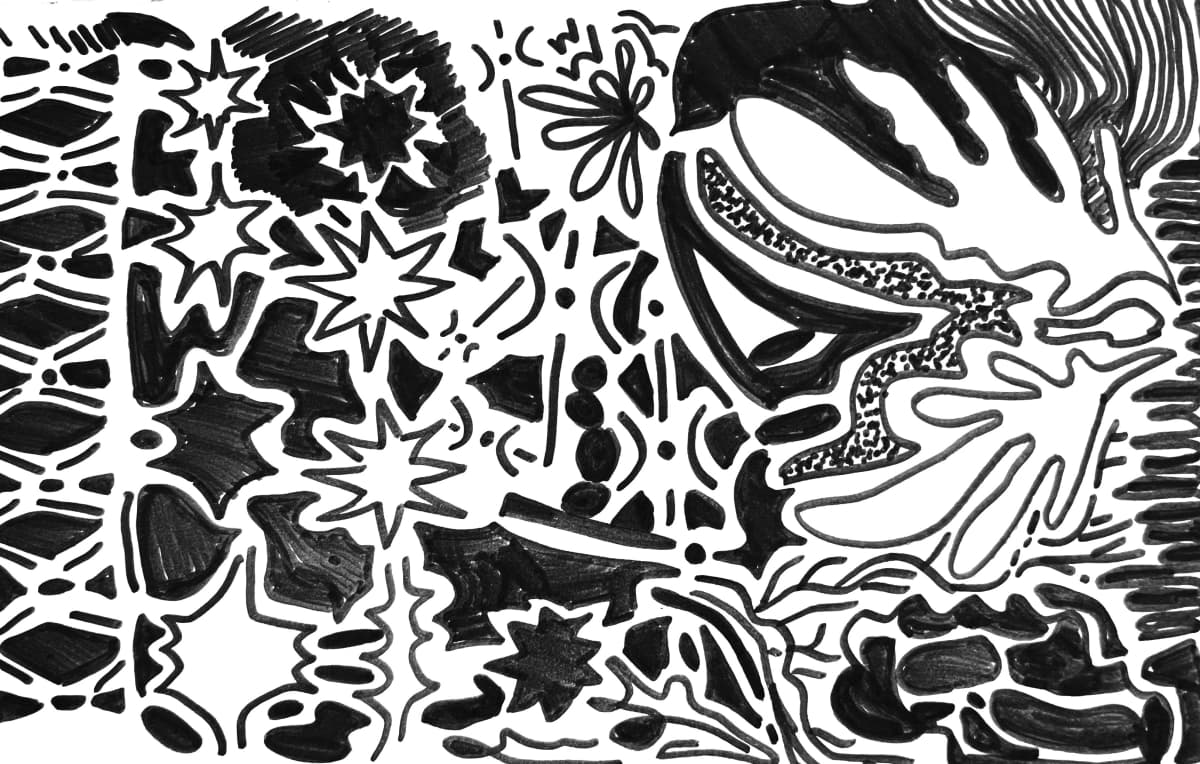
My stream of consciousness ebbs and flows with the ink of my pen as the unknown unfolds on the page before me.
The thoughts that rush through my mind as I draw are the same that I often have about life. Growing up, I routinely confronted the unknown. Having moved between schools, cities, and countries numerous times growing up, I became accustomed to embracing the unknown. As an adult, I realized I am not as brave as I once thought I was. When a decision is fully mine, I often experience decision paralysis, the fear of the unknown, and the fear of failure. This job, that school, this country, that city. What if the only stable job for me is in a city that I don’t want to live in? What if my ideas never reach the right people? I wish I could do whatever I wanted and not think about money.
I let intuition and the natural flow of ink guide me. For the first time in weeks, I explore the movement of pen on paper for the sake of it. Between some lines, I still battle the fear of ruining a blank space. But I remember that art is not a means to an end. Creation in itself is good, and beauty exists even in my messy smudges.
As I look up at my clock, I am reminded that art is a slow and unpredictable process. It is antithetical to the pragmatism that permeates our culture. Technically, making art reduces the amount of time that I can spend on coursework or internship applications today. One might call my art useless. This is true, but only if “usefulness” is measured through the lens of profitability or functionality. Creating is productive for my soul– drawing teaches me patience and reveals how beauty prevails through imperfection.
In many ways, pragmatism has sucked the joy out of the way we approach academics, vocation, and even relationships. Pragmatism tells us that a person’s status is found in their grades, employability, or in how much they meet the wants and needs of others. Art offers an alternative; it illuminates the dignity of existence in itself.
Co-laboring with God
After He created mankind in His likeness (Genesis 1:26), “God saw all that he had made, and it was very good” (Genesis 1:31). Because we are made in God’s image, we are inherently valuable. Being made in God’s image also means we are creative by nature. We are not called to passively live on this earth, but to actively co-labor with God. We see this in the Bible as early as Genesis 2, when God invites Adam to name each animal, and honors Adam’s creative choices:
“Now the Lord God had formed out of the ground all the wild animals and all the birds in the sky. He brought them to the man to see what he would name them; and whatever the man called each living creature, that was its name. So the man gave names to all the livestock, the birds in the sky and all the wild animals.” (Genesis 2:19-20).
In Exodus 31, the first person to be filled with the Spirit of God is introduced: an artist.
“Then the Lord said to Moses, “See, I have chosen Bezalel son of Uri, the son of Hur, of the tribe of Judah, and I have filled him with the Spirit of God, with wisdom, with understanding, with knowledge and with all kinds of skills— to make artistic designs for work in gold, silver and bronze, to cut and set stones, to work in wood, and to engage in all kinds of crafts.” (Exodus 31:1-5).
This passage reveals several details about God’s attitude toward art. An artist being the first person to be filled with the Spirit shows us that God values craftsmanship and is intimately involved in the creation process. After all, when we create, we mirror our Creator. Moreover, we see that God equips man with the ability to create. Despite how small and limited we are in comparison to the magnitude of His holiness and glory, God calls and desires us to co-labor with Him. When a person is filled with the Spirit, their hands become vessels for revealing truth about the divine.
The passage outlines four things that are given to Bezalel so that he may create: wisdom, understanding, knowledge, and skill. Good art is not simply a product of our own thoughts and tastes, but of wisdom, understanding, knowledge, and skills given to us by the Lord.
James describes heavenly wisdom as “first pure, then peaceable, gentle, open to reason, full of mercy and good fruits, impartial and sincere.” (James 3:17). As we create art, we must examine our hearts and pray for discernment between worldly and heavenly wisdom. If we find that our motivation for creating art does not align with the heavenly wisdom described in James, we need to reevaluate our process.
When I struggle to draw something, I sometimes decide to give up, cross it out, or rip it out of my sketchbook entirely. However, art is most edifying when I practice and see improvement in my craft. For an artisan, honing one’s skills is not only necessary, but an act of worship. When we steward our minds and bodies by actively using our skills, we glorify God. In his letter to the Colossians, Paul encourages the church to engage their whole heart in work: “Whatever you do, work at it with all your heart, as working for the Lord, not for human masters, since you know that you will receive an inheritance from the Lord as a reward. It is the Lord Christ you are serving.” (Colossians 3:23-24). Proverbs 22:29 also highlights the value of skill: “Do you see someone skilled in their work? They will serve before kings; they will not serve before officials of low rank.”
The last verse in the passage highlights the value of working across a variety of media for creative expression. Working with gold, stone, and silver each entails a unique set of challenges, victories, and experiences of awe. Why did God make gold shine? Why did he create stone to feel the way it does? One might ponder these questions throughout their creative process. Each medium can teach a new aspect of God as an artist. After all, it is God who created these materials. As David expresses in the Psalms, "Let the heavens rejoice, let the earth rejoice; let the sea roar, and all that fills it. Let the field exult, and everything in it. Then shall all the trees of the forest sing for joy” (Psalm 96: 11-12).
I am constantly filled with awe and wonder when I experience creation. I find great joy in standing next to a tree and being engulfed by the presence of something greater than myself. If the grandness of a tree provides me with a mere glimpse of the majesty of the Creator who sculpted it, I cannot fathom standing in the fullness of His glory. I am not even a speck in this universe, and there is so much beauty and wonder to be held that I have not yet seen. Still, I can imagine the beauty that I have not yet seen.
When we imagine and shape the new into existence with the resources God has given us, we closely mirror the actions of our Creator. We cannot create something out of complete nothingness; only God can do this. However, imagination allows us to get quite close. After I draw something in my sketchbook, I am filled with the satisfaction of beholding something that has freshly come into existence. Our imagination is a crucial part of what makes us human; that is, it is what makes us in the likeness of God. Allowing ourselves to experience childlike awe and wonder is key to the process of creating. We must embrace our God-given imaginations to illuminate beauty in His world.
Art in Ordinary Spaces
The natural world is a divine work of art. The heavens declare the glory of God, and the sky above proclaims His handiwork (Psalm 19:1). God not only provides us with artistic inspiration through His Creation, but with the tools to partake in new creation with Him. In his essay “A Piece of Chalk,” G.K. Chesterton writes about going on a walk to draw outside. At a certain point, he realizes that he has left the house without a piece of white chalk. He initially sits in despair, but has the realization that he can simply break off a piece of rock from the land he is sitting on and use it as a piece of white chalk. The piece ends with these lines:
“And I stood there in a trance of pleasure, realising that this Southern England is not only a grand peninsula, and a tradition and a civilisation; it is something even more admirable. It is a piece of chalk.” - G.K. Chesterton, A Piece of Chalk
Our Lord paints with the land and everything in it. I view the contour of hilltops, the patterns on leaves, and the windy movement of grass as His brushstrokes. Beholding and appreciating beauty in the mundane is a sacred experience. We have the privilege of being able to contribute to this beauty with the tools and imagination that God has given us. However, it feels that modern manmade spaces often fail to make room for people to experience awe and wonder.
Before mass production permeated our lives, creation was generally a slow and intimate process. Now, speed and uniformity are the norm. For example, architecture around the world that predates industrialization and globalization holds a cultural and temporal uniqueness in its artistic expression. Today, new urban developments around the world take the form of standardized, indistinguishable boxes that are quickly constructed in the span of a few months. As an urban design student, this is one of the aspects of cities I most dislike. Modern buildings are products and financial assets rather than works of art. Art takes time, and while the beauty of a slowly crafted building with an artisan’s touch might bring joy to the ordinary person, it does not maximize a real estate developer’s annual return-on-investment.
However, creation that is driven primarily by profit and efficiency distances us from the act of creating out of love. Rather than mirroring our Creator, we easily become focused on ourselves and our own desires. The best kind of manmade creation is that which is co-created with the Spirit. When we create with and for God and not just for ourselves, we draw attention to His beauty and venerate His own creativity rather than ours.
I will never forget the feeling of entering Saint Peter’s Basilica. Upon entering the church, I was immediately awestruck. I stood in sheer wonder as I looked up at the ceiling for minutes before I moved to a new part of the church to gape at its magnificence from another angle. Not only did the church’s grand sense of scale instill in me a consciousness of how small I was under its painted heavens, but under Heaven itself. In modern buildings, one’s gaze is rarely drawn upwards. However, in the basilica, the physical act of looking toward the heavens while contemplating the message of its artwork became a form of meditation. The role of Michelangelo’s faith in his design of the basilica’s dome is also fascinating to me. Giorgio Vasari’s biography of the artist records that he refused to be paid for his work on the basilica. Michelangelo “desired that it should be put into the agreement that he served for the love of God and without any reward.” Art that centers God rather than ourselves is not only a way to love God, but to love others. Even outside of the basilica, I continuously found amazement in being able to wander the streets and walk into an unassuming church with heavenly artwork. When a city itself is art, grandeur becomes accessible to the common person.
Despite my qualms with modern architecture, I do not mean to say that mass production itself is wrong. In fact, the ability to mass-produce has led to many positive outcomes for humanity. For example, Gutenberg’s movable type printing press, one of the earliest vehicles of mass production, allowed for the distribution of information at previously impossible rates. It made education and scripture widely accessible to common people. Mass production can glorify God and exist in harmony with artisanry. My fatigue with mass-produced aesthetics stems from soulless creation driven by profit maximization. Slowness is counterintuitive to our capitalistic culture, but enables making to be a Spirit-filled effort.
Imago Dei
Although my process might be slow, once my ideas take physical form, I can share them with others. Art gives physicality to the images in my mind and provides a glimpse of who I am. Similarly, humans as God’s creation reveal much about the Creator Himself, as we are made in His own image (Genesis 1:27). Christ further amplifies our understanding of God. In Christ, God presents the fullness of His deity in physical form (Colossians 2:9).
I make art because it brings me joy, rather than for any strategic reason. Similarly, God created us out of love, not out of necessity. At the core, we were created to be loved. We were not created for any functional assistance to God, as He is already all-powerful. Creating is a natural result of God’s overflowing love for others. The Trinity has eternally existed in loving community. God’s inherent love comes from the eternal and selfless love between Father, Son, and Spirit: one being of three consubstantial and coequal yet distinct persons. He did not “become” loving once He had others to love; He has eternally been a loving God by nature of His triune being.
The purpose of life is not so complicated. We ultimately exist to love and be loved by our Creator, who is the true and ultimate source of love (1 John 4:16). Every person fundamentally desires to be loved and to be known. It is when we have a personal relationship with the One who created us that we can experience life as we were designed to.
When we long for love, joy, and peace, we long for God. He is the giver of life, and no creation, regardless of its beauty, can fulfill what only our Creator can provide. As expressed by French mathematician and philosopher Blaise Pascal, “There is a God-shaped vacuum in the heart of each man which cannot be satisfied by any created thing but only by God the Creator.” Our experience of beauty and transcendence in art and God’s creation provides us with a mere glimpse of God’s infinite majesty.